Monday, September 13, 2010

Founding Father Insults, Vol. 2

Collected in the Philadelphia "Port-folio" in 1802, and is cited as having been written by "THE SAGE OF MONTECELLO." To the tune of "Yankee Doodle," if you will.

Et etiam fusco grata colore Venus. - Ovid

Of all the damsels
on the green,
On mountain, or in valley
,
A lass so luscious ne'er was sen
As Monticellian Sally.

Yankee doodle, whose the noodle?
What wife were half so handy?
To breed a flock, of slave for stock,
A blackamoor's the dandy.

Search every town and city through,
Search market, street a
nd alley;
No dame at dusk shall meet your view,
So yielding as my Sally.
Yankee doodle, &c.

When press'd by loads of state affairs,
I seek to sport and dally,
The sweetest solace of my cares
Is in the lap of Sally.
Yankee doodle, &c.

Let Yankee parsons preach their worst—
Let tory Whittling's rally!
You men of morals! and be curst,
You would snap like sharks for Sally. *
Yankee doodle, &c.

She's black you tell me—grant she be—

Must colour always tally?
Black is love's proper hue for me—
And white's the hue for Sally.
Yankee doodle, &c.

What though she by the glands secretes;
Must I stand stil-I shall-I?
Tuck'd up between a pair of sheets
There's no perfume like Sally
†
Yankee doodle, &c.

You call her slave—and pray were slaves
Made only for the galley?
Try for yourselves, ye witless knaves—
Take each to be your Sally.

Yankee doodle, whose the noodle?
Wine's vapid, tope me brandy—
For I still find to breed my kind
A negro-wench the dandy!

_____


* It appears that neither of the lovers agree with our Milton, who represents the angel Raphael, upon being asked the question whether t
he Heavenly Spirits love! answering

With a smile that glow'd
Celestial rosy RED, love's proper hue.

But de gustibus non disputandem—The Montecellian lovers are not altogether angels.

† They (the blacks) secrete less by the kidnies, and more by the glands of the skin, which gives them a very strong and disagreeable odor.

Seems the tea-baggers are in good historical company, no? For reference purposes, though, all of the italicizations are from the original text, if you can believe it — though, the image was not. It certainly makes Jon Stewart's political commentary seem more tame.

Tuesday, August 31, 2010

Alaskans sing out

This isn't as funny as it could've been -- which is saying something for a combination Gilbert-and-Sullivan-anti-Sarah-Palin-attack-ad.

Tuesday, August 17, 2010

Singing through countless ages

As if we needed any more reasons to loathe the voice of Christians crying out for the realization of their religious fervor (and Catholics, I mean you, too) the Christian (and Jewish, if you can believe it) reaction to xenophobically misnomered 'Ground Zero Mosque' is doing it's best to give us one.

Setting aside the question of the mosque's propriety, constitutionality, sensitivity, relevance, etc., isn't it enough for Christians to know that their detractors will burn in an everlasting holocaust of pain and despair? I can't imagine that oppressing them for the blink of time that is their earthly existence is going to have much of an effect.

But then again, I'm not this guy.

Founding Fathers Insults, Vol. 1

John Adams, regarding Thomas Paine's The Age of Reason:
I am willing you should call this the Age of Frivolity, as you do, and would not object if you had named it the Age of Folly, Vice, Frenzy, Brutality, Daemons, Bonaparte, Tom Paine, or the Age of the Burning Brand from the Bottomless Pit, or anything but the Age of Reason. I know not whether any man in the world has had more influence on its inhabitants or affairs or the last thirty years than Tom Paine. There can no severer satyr on the age. For such a mongrel between pig and puppy, begotten by a wild boar on a bitch wolf, never before in any age of the world was suffered by the poltroonery of mankind, to run through such a career of mischief. Call it then the Age of Paine.

Tuesday, July 13, 2010

Losing the use of our feet

Fear not: this isn't a post running down the automobile. It's one about how to use them more efficiently. 'Pologies, Mr Berry.

Think about the last time you drove down a major thoroughfare (say, a road with four+ lanes). In the words of "Tommy Boy," you're driving along and you're driving along, and lo, you and eight-ten other cars have to stop suddenly at a stoplit (or a stop signed) intersection to let perhaps one or two cars out onto the thoroughfare. While one or two such stops in a trip might be more or less expected, my suspicion (evinced largely by anecdotal and personal experience) is that numerous such stops are what precipitate road rage and, in general, traffic anxiety. Indeed, city and especially suburban driving can be especially frustrating because of the prevalence of such intersections along widely used roads.

Now, it's clear that such stopping and going introduces a significant inefficiency into travel plans bedeviled by such intersections. To illustrate, consider progress along your car's route in two respects: the route your car actually takes and the route it would take if there were no stoplights or signs or what have you. Call the first route the "actual route," and the second the "ideal route." The degree that your actual route approaches your ideal route (as with most things) might be considered the degree to which your travel is efficient. Thus, the most efficient travel will be that which is least encumbered by stopping, and the most inefficient travel will be that which is most encumbered by stopping.

So, here's the more or less normative claim: at least one responsibility of traffic authority is maximizing travel efficiency. Thus, considered in light of that one responsibility, traffic authorities ought to eliminating as much stopping as possible; or put differently, traffic authorities ought to increase the relative amount of "going."

Given these preliminaries, it's pretty obvious that (at least) stop lights at the intersections of major roads and non-major roads (say, at a four lane road and the entrance to any private business, like a Wal-Mart, Target, or shopping center) are enormously inefficient and represent an abrogation of the traffic authorities responsibilities.

As bad as the inefficiency is, though, there's another way of putting this problem that ought to burn the biscuits of most semi-liberal anti-Wal-Mart types. If people had to wait significant periods of time when leaving their local big box store (or making a left-hand turn in to them, for that matter) the added time might well discourage them from patronizing that establishment. So, people who frequent large shopping centers and other businesses that have such stop lights slowing down traffic are going to be willing to suffer the extra time added to their schedules, because they know that on some future occasion, they'll be the benefactors of the inefficiency. In other words, the inefficiency is a sort of tax they're willing to pay because they know they'll benefit from the tax eventually.

I see two interesting corollaries of that traffic inefficiency tax.
  • First, even a general willingness to pay the tax doesn't reduce the aggregate inefficiency. Now, this is an empirical question that (obviously) I haven't tested. But anecdotally, I submit that very seldom is it the case that the number of people waiting at the minor thoroughfare will outnumber those inconvenienced by the stop at the major thoroughfare. This seems right, for one, because if it were often the case that more people used the minor than major thoroughfare, the minor thoroughfare wouldn't be the minor one; and for two, even when more people are inconvenienced at the minor thoroughfare, we can account for this with sensored traffic lights that detect the number of cars waiting at the minor stop.

  • Second, by supporting these sorts of inefficiencies with our tax dollars, we're usually offering tacit (but definitely effective) public support for the sorts of places where one often finds such stoplights. In my experience, these are usually large shopping locations and housing developments in rural locales. Think about these sorts of housing developments: would wealthy suburbanites so willingly flee the suburbs to more far-flung towns, if they knew their already considerable commutes would often be lengthened considerably by significant waits just trying to get out of their housing developments and onto the road? Many might, but my guess is that at least some wouldn't.
And further along these lines, how often does one notice such lights at the entrances to our more community-oriented and local establishments? By making it more difficult to enter and exit such places (and additionally, by making it easier to enter and exit the competition) our communities make it that much harder for non-ideologues to discover the places about which the rest of us are ideological.

All of that is just to say that there are very small but very effective ways that our communities tend to encourage the sorts behavior that are, themselves, anathema to community. Why make it easier to shop at businesses whose owners (and, often, employees) have no interest in the health of the place? Why make it easier for the same sorts of people to turn our farms into further sprawl? And not only that, free marketeers (read: Republicans) ought to stand in the way of these sorts of measures, since the measures create an artificial demand for living and shopping in these locations.

Do you have experiences like this, or am I preaching to an empty choir here?

Friday, July 2, 2010

I Maintain My Objection to Popular Things

Theodore Dalrymple, besides having a spectacular name, is quite right about soccer (er, football). Towards the end of his entirely reasonable article on snobbery, he sums up my thoughts:
On the subject of football, I am a snob. I do not detest the game as such, for I accept that it can be played with skill and achieve a kind of beauty, but rather the excessive importance attached to it by millions and hundreds of millions of my fellow beings. Try as I might to expunge the thought from my mind that this enthusiasm is a manifestation of human stupidity, I cannot.

Wednesday, June 30, 2010

Context Sensitive

Living in DeKalb keeps me, alas, on the move in car rides of pretty appreciable distances. While one might rightly loath such a loathsome fact about my present condition, it's chief benefit has been the opportunity it affords me to listen to books on tape (that is, CD) that I might not otherwise have had time or excuse to pick up. In the last two-ish months, I've listened to Richard Russo's Empire Falls and Bridge of Sighs, to Joseph Ellis great biography of Washington, His Excellency, and as well to John Adams, McCullough's sort of meandering titular biography.

I'll leave for another time discussion of the changed experiences of listening to rather than reading a book. What I want to note now is a bit of appreciation I've gained for just how intriguing were times in which the American Founders lived--and how little most contemporary Americans probably really know of them.

For instance, I'd be interested in a poll that asked people to correctly determine what claim to fame made John Adams a shoe-in for the first Vice-President of the United States. I can say with some shame that I had no knowledge of Adams' meeting with the British Admiral Howe (or that Howe-the-Elder's [sic] younger brother was a general who commanded the British ground force before Cornwallis) that very nearly brought a peaceful end to the Revolution not one year after its inception; or of his work in France during the Revolution; or of the praise he received for securing two multi-million dollar Dutch loans, despite British threats against the Dutch navy; or that he served as the first American Ambassador to England, just a few months after the war ended.

Or that despite the historical attention paid to the animosity between Jefferson and Adams, until Adams became Vice-President, the two had been rather close friends. Jefferson and Adams had vacationed together while Adams was Ambassador to England and Jefferson to France. Abigail and Jefferson had a lengthy (if, toward the end, very terse) correspondence. Abigail had, while in England with John, cared for Jefferson's daughter for several months. And John Quincy Adams wrote of many a formative hour spent in the company of Thomas Jefferson, when both families resided in Paris.

No, the real hatred between revolutionaries was between Alexander Hamilton (Federalist) and Jefferson and James Madison (Republicans). I recommend the Adams and especially Washington biographies in large part because of the number of hilarious insults it unearths with respect to this particular hatred. For instance, in a letter to Washington after Jefferson had retired as Secretary of State and Hamilton remained Secretary of the Treasury, Jefferson (ever the xenophobe) writes of Hamilton:
"I will not suffer my retirement to be clouded by the slanders of a man whose history, from the moment at which history can stoop to notice him, is a tissue of machinations against the liberty of the country which has not only received and given him bread, but heaped its honors on his head."
In another letter, this time to Madison, Jefferson writes of a speech Washington gave before leading American forces against the Whiskey Rebels. The speech contained "a parcel of shreds of stuff from Aesop's fables, and Tom Thumb," which sufficed to convince Jefferson that that speech had been written by Hamilton. Snap!

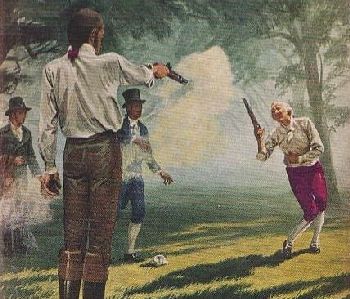
To really get a grip on that hatred, it's hard to forget that one of Jefferson's closest allies and the Vice-President of the United States killed Hamilton in a duel. I mean, he killed him! Now the story is shrouded in more than a little mystery and intrigue, but here's how I understand it, after having read a few historical accounts. By the beginning of the 19th century, death by pistol-duel had become a pretty uncommon way to die, given that the practice had devolved into a sort of gentleman's face-saving event. At this time, the order of operations began with one man taking the first shot, unencumbered by cross-fire from the second, since it was assumed by the second that the first would purposefully mis-aim and fire to the second shooter's right or left. Then, the second shooter would do the same. Each man, having defended his respective honor, then departs the field.

Of course, that's not how it went down in Burr v. Hamilton's torso. The story is that while Hamilton may have, indeed, intended to purposefully miss Burr, Hamilton nonetheless shot the branch immediately above Burr's head. According to Burr's supporters, the breach in protocol left Burr uncertain as to whether Hamilton had accidentally or intentionally mis-fired, and Burr unwilling to give Hamilton the opportunity to be more forthcoming in his intentions (the two used single-shot Wogdon pistols, as the flintlock revolver was not invented until 1814 or so), shot Hamilton in the abdomen, whereupon Hamilton promptly died 36 hours later.

Interesting, those lives and times. Reader, I entreat you to think upon just how much America has changed from then to now. From a time when the Vice-President could shoot the Secretary of the Treasury, to a time when the Vice-President can only shoot a lawyer. That's a long way, I know. The more amusing image, of course, is that of Joe Biden mortally wounding Tim Geithner. Now that, I should think, really would be a bfd.